From the conversion glossary
Concepts referenced in this article, defined.
Multi language website CRO goes beyond translated text - currency, trust signals, and local buying habits. A practical guide to real ecommerce localization.
Concepts referenced in this article, defined.
 cro
croPre-order waitlist CRO strategies that convert hype into real revenue - how to design waitlist and pre-order pages that don't lose momentum before launch.
 cro
croFirst purchase experience optimization - practical strategies to turn first-time visitors into buyers, from welcome offers to a smarter new customer funnel.
 cro
croRetail media CRO explained - how to monetize on-site ads and sponsored placements without tanking your conversion rate. A practical balance guide.
Run rigorous A/B tests and personalize every visit on Shopify or any storefront — no engineers required.
A store that swaps its English copy for French, or its dollars for rupees, has translated its website. It hasn't necessarily localized it.
Translation changes the words. Localization changes whether the experience feels native, trustworthy, and easy to buy from. The gap between the two shows up in conversion rate, even when shoppers cannot quite explain why a translated page feels off.
Multi language website CRO is about closing that gap, and it usually has less to do with translation quality than most brands assume.
A product description that reads perfectly in English can feel stiff, awkward, or confusing when translated word for word. Idioms do not always carry over. Persuasive phrasing that works in one culture can feel pushy or strange in another. Shoppers do not need to consciously notice weak translation for it to affect them. An oddly worded page simply feels less trustworthy, even when every fact is correct.
An ecommerce localization strategy treats this as a content and cultural problem, not just a language-swapping task. The goal is copy that reads the way a native speaker in that market would actually write it.
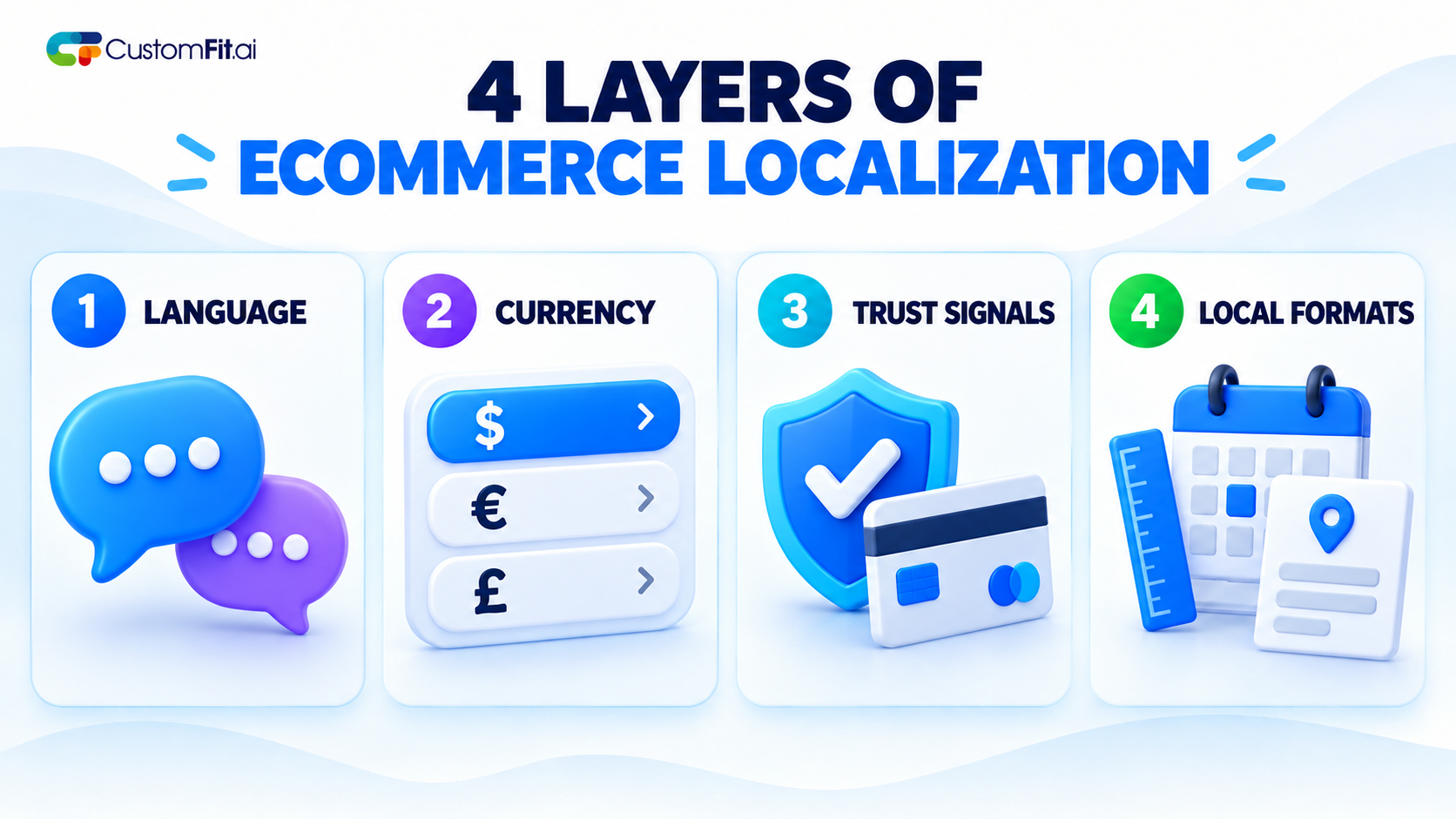
Use detection as a default, but keep manual choice open. Guessing a visitor's likely currency based on location is reasonable. But someone traveling, using a VPN, or simply preferring a different currency still needs an obvious way to change it. A selector buried in the footer is rarely obvious enough.
Show a price that feels natural in the target market. A technically correct conversion can still produce an awkward number. For example, a price such as ¥3,847 may look less deliberate than a locally familiar price point. Present the genuine local price, not only the mathematical conversion.
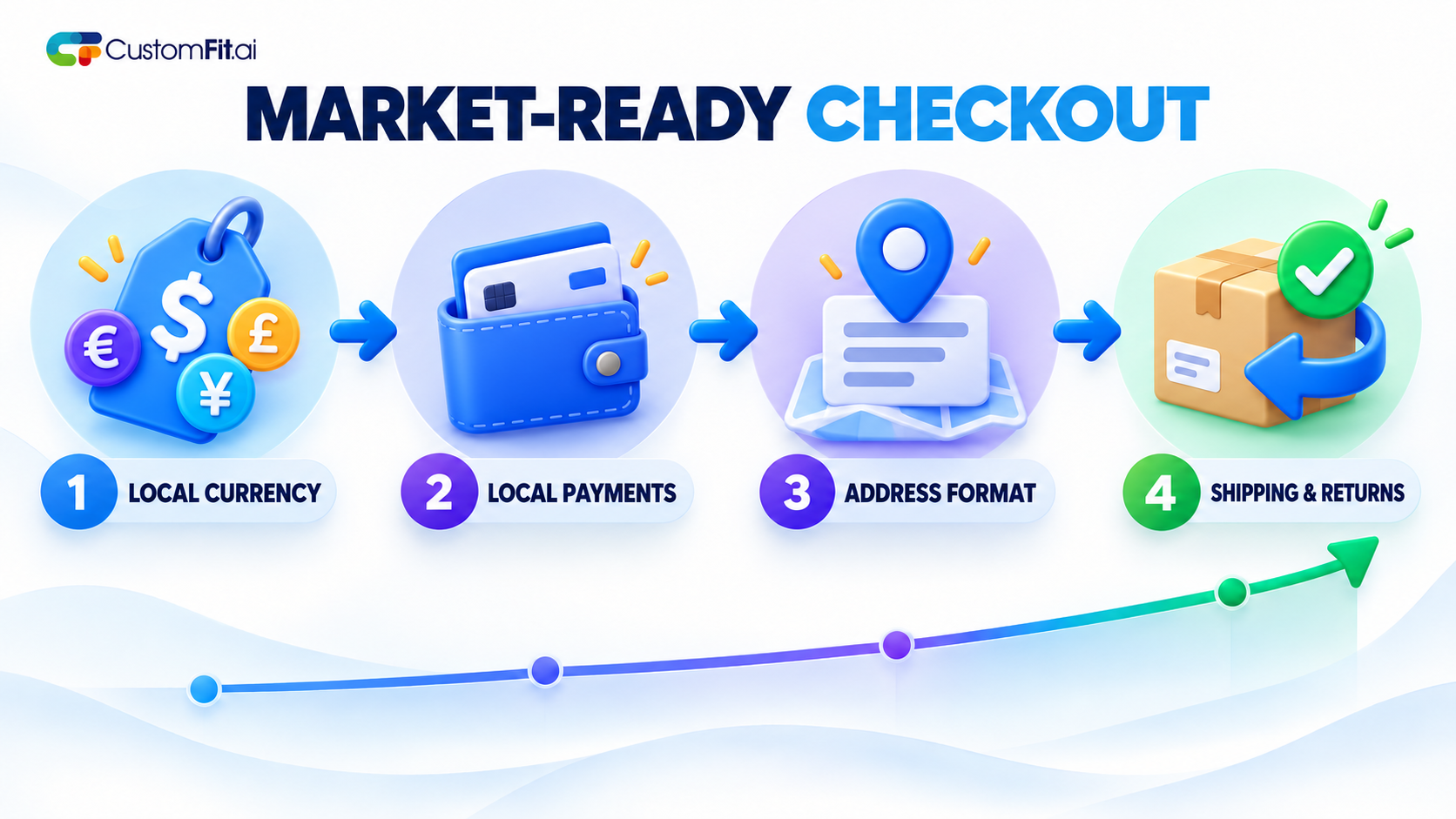
Make shipping and tax costs clear in the local currency early. Currency confusion gets worse at checkout. A shopper who compares products in one currency but sees shipping or duties in another has to stop and calculate at the exact moment you want the purchase to feel easy.
Keep the currency consistent throughout the journey. A product page, cart and checkout where the currency changes will create doubt when trust matters most.
Localize your proof, not just your copy. You need to adapt your trust signals along with the product content. A popular payment method, security badge, or review platform in one country may carry little weight in another.
Convert sizes, weights, and measurements automatically. Shoppers should not have to turn inches into centimeters or decode an unfamiliar sizing system. This small point of friction can quietly undermine an otherwise strong product page.
Localize dates, formats, and address fields. A checkout built around a US address structure, or a date written in an unfamiliar order, creates avoidable uncertainty. Checkout is the worst place to make shoppers pause and interpret a form.
Have a native speaker review important machine-translated pages. Automated translation has improved, but it can still produce mistakes that a native speaker catches instantly. A quick human review pass on key pages, such as the homepage, best-selling product pages, and checkout, is worth the effort even if the rest of the catalog remains automated.
Choose subdomains, subdirectories, or separate domains deliberately. This is both a technical SEO and UX decision. The structure should make it clear that the shopper is on the version of the store designed for their market.
Localize your payment methods, not just your currency. Some payment methods are expected in specific markets, including particular digital wallets, bank transfer systems, and buy-now-pay-later providers. Leaving them out can be a hard blocker for shoppers who otherwise want to buy.
Adjust your shipping and returns policy transparently by region. Delivery times, duties, and return logistics can vary widely between markets. A single global policy can create confusion that localized policy pages would prevent.
Test with buyers from the target market. A native speaker can check grammar, but a potential customer can tell you whether the pricing, trust signals, and checkout flow feel natural. That is harder to measure and more valuable to get right.
The most common mistake is treating localization as a one-time translation project. New products, promotions, and seasonal campaigns need the same attention as the original store launch, yet they often do not receive it.
The second mistake is assuming machine translation is sufficient for every page. Automated tools can handle volume, but the highest-traffic and highest-stakes pages still benefit from a native-speaker review.
Multi language website CRO is rarely about translation quality alone. It is about whether the experience, from currency and trust signals to checkout fields, feels genuinely built for that market rather than adapted from another one.
Brands expanding internationally often find that fixing localization gaps unlocks meaningful conversion improvements because localization has been treated as a checkbox instead of an ongoing part of the customer experience.