From the conversion glossary
Concepts referenced in this article, defined.
Concepts referenced in this article, defined.
 cro
croPre-order waitlist CRO strategies that convert hype into real revenue - how to design waitlist and pre-order pages that don't lose momentum before launch.
 cro
croFirst purchase experience optimization - practical strategies to turn first-time visitors into buyers, from welcome offers to a smarter new customer funnel.
 cro
croRetail media CRO explained - how to monetize on-site ads and sponsored placements without tanking your conversion rate. A practical balance guide.
Run rigorous A/B tests and personalize every visit on Shopify or any storefront — no engineers required.
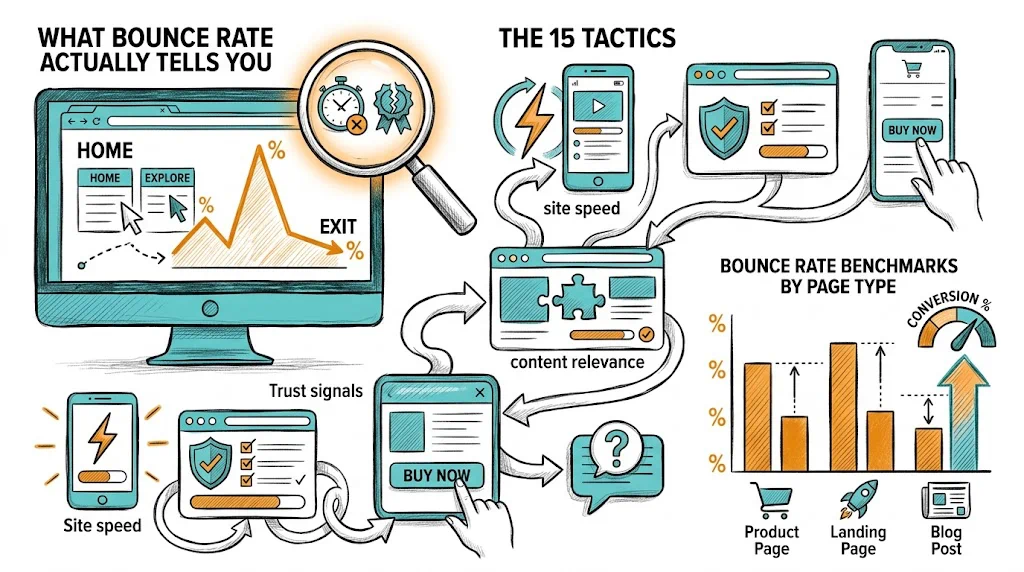
Bounce rate is the percentage of visitors who leave your site after viewing only one page — and for ecommerce, a bounced visitor is a missed sale. Reducing bounce rate is not about trapping visitors; it's about making your landing page so relevant and trustworthy that visitors want to continue. The 15 tactics below target the real reasons visitors bounce: speed issues, trust deficits, content mismatches, and mobile friction. Brands that implement these systematically typically see 15–30% bounce rate reductions within a quarter.
Before optimizing, understand what bounce rate data means:
High bounce rate on the homepage: Visitors aren't finding what they expected or a reason to explore. Problem areas: headline clarity, navigation, page speed, or traffic source mismatch.
High bounce rate on product pages: Visitors aren't convinced to add to cart or explore further. Problem areas: trust signals, product images, price clarity, or audience targeting.
High bounce rate from paid traffic: Your ad promise and landing page experience are mismatched. The ad says one thing; the page delivers something else.
Low bounce rate overall (under 20%): Check if your analytics is counting inter-page navigation as separate sessions — sometimes a low bounce rate indicates a tracking configuration issue rather than excellent performance.
This is the highest-priority tactic because slow pages cause immediate bouncing before visitors even see your content.
Data: Pages that load in under 2 seconds have a 15–20% lower bounce rate than pages loading in 4+ seconds. On Indian 4G connections, this gap is even larger.
How to fix:
Target: Under 3 seconds on mobile for 4G connections (test with Google PageSpeed Insights, mobile tab).
The #1 cause of bounce rate from paid traffic is the gap between what the ad promises and what the landing page delivers. If your Instagram ad shows a "30% Diwali Sale" and the landing page is your standard homepage, visitors bounce immediately.
How to fix with CustomFit.ai:
This single change typically reduces paid traffic bounce rate by 20–35%.
If a visitor can't quickly find what they're looking for on mobile, they leave. Mobile navigation that requires multiple taps, uses confusing labels, or hides important categories causes bounce.
Audit your mobile navigation:
First-time visitors from new channels (paid social, influencer) have no prior trust in your brand. Showing trust signals before they scroll reduces the "is this site legit?" bounce.
Trust signals that work above the fold:
Your hero section (first screen on homepage) has 5 seconds to convince a visitor to stay. If the headline is generic ("Quality Products for Everyone"), visitors bounce.
Winning formula:
Test hero variants with CustomFit.ai. See our A/B testing homepage guide for the full framework.
Exit-intent popups — triggered when the user's cursor moves toward the browser close button (desktop) or after a set time on mobile — can catch bouncing visitors with a compelling offer.
Done right:
Done wrong:
A visitor who sees an interesting link to another page on your site is less likely to bounce. Improve internal linking by:
New visitors and returning visitors have different needs:
Showing a generic experience to both groups means you're underserving both. Use CustomFit.ai's personalization targeting to show different hero content based on visit history.
Visitors who search for products are high-intent — they know what they want. If your search returns irrelevant results or zero results for common queries, they bounce immediately.
Audit your search:
Category pages with too many options, poor filtering, or confusing layouts cause decision fatigue — and bouncing. Simplify:
Every product has objections that prevent purchase. For skincare: "Will this work on my skin type?" For supplements: "Is this safe?" For fashion: "What if it doesn't fit?"
Address these objections proactively on the landing page — don't make visitors search for answers. Find your top objections from customer support tickets and reviews, then ensure the product page answers each one.
Visitors respond differently to imagery based on their demographics and context. Use CustomFit.ai to show:
This reduces the "this brand isn't for me" bounce that occurs when visitors don't see themselves represented.
Too many popups — newsletter, exit-intent, push notification requests, chat bubbles — create a chaotic first experience and increase bounce rate.
Audit rule: No more than one popup per session, shown after at least 15 seconds on page. Disable push notification requests on mobile entirely.
If you drive traffic via content marketing, ensure your blog articles fully answer the visitor's question — not just tease an answer to drive product page visits. Short, thin blog posts drive high bounce rates and hurt SEO.
Target articles with heatmap analysis (Microsoft Clarity is free): if users aren't scrolling past the introduction, your content isn't compelling enough.
For pages with bounce rates above 60%, don't guess — test. Form a hypothesis about what's causing the bounce and run an A/B test with a variant that addresses it.
Example: If your "Hair Care" category page has 68% bounce rate from paid social:
Use CustomFit.ai to run this test without developer involvement. See best A/B testing tools for ecommerce for options.
| Page Type | Good | Average | High (Needs Work) |
|---|---|---|---|
| Homepage | 25–40% | 40–60% | 60%+ |
| Category pages | 30–50% | 50–65% | 65%+ |
| Product pages | 30–50% | 50–65% | 65%+ |
| Blog/content | 55–75% | 75–85% | 85%+ |
| Checkout start | 15–30% | 30–45% | 45%+ |
Bounce rate is a leading indicator of conversion rate problems. A visitor who bounces can't convert. But fixing bounce rate alone isn't enough — you need to convert the visitors who stay.
The optimization sequence:
See CRO Process: Step-by-Step Framework for the full methodology.